NASA for Kids: How Space Agencies Inspire Young Scientists
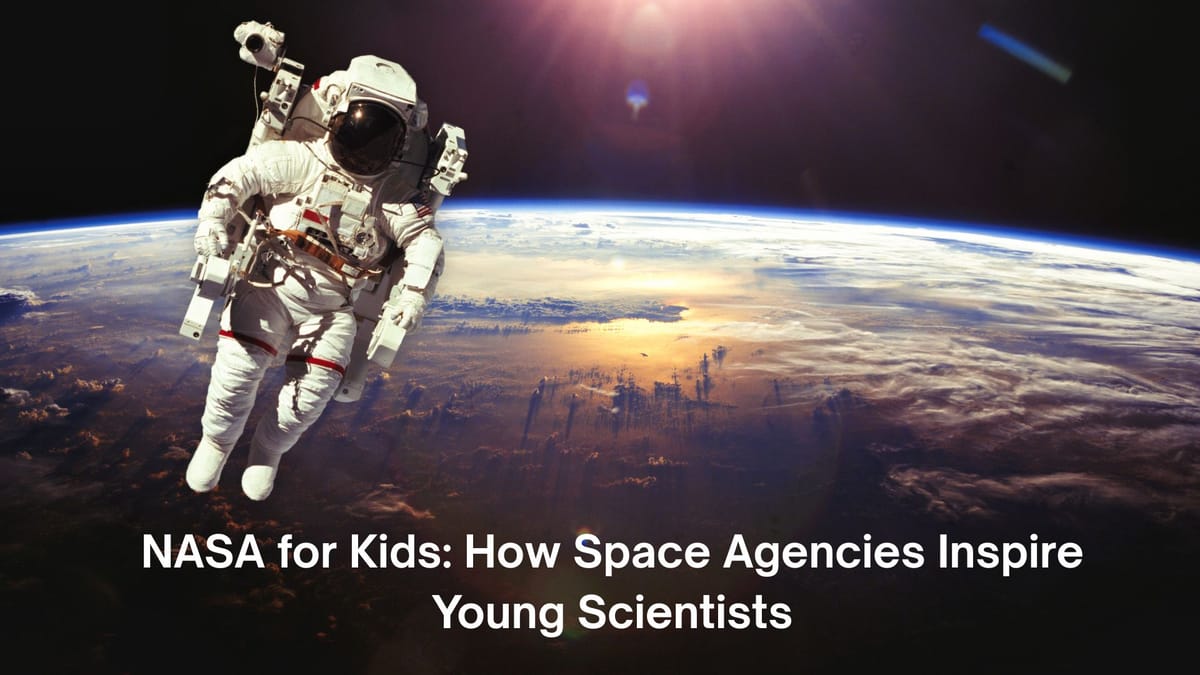
Have you ever looked up at the stars and wondered what it would be like to drive a rover on Mars or float inside a space station? For generations, space agencies have turned these wild childhood dreams into real-world scientific passions. Initiatives like NASA for kids bridge the gap between imagination and reality by offering interactive games, virtual rocket launches, and student challenges that make complex physics feel like a grand adventure.
Globally, this cosmic spark isn't unique to the United States; parallel programs like ISRO for students are doing the same thing across India, proving that no matter where a child is born. The night sky speaks a universal language that inspires the next generation of world-changing scientists.
Let's do an in-depth exploration of how these space giants motivate future scientists and discover how you can bring this stellar magic directly into your child's weekly routine!
The Global Pioneer: Unleashing Curiosity with NASA for Kids
For more than half a century, the National Aeronautics and Space Administration (NASA) has pushed the absolute boundaries of human knowledge. From landing astronauts on the lunar surface during the Apollo missions to transmitting stunning, crystal-clear images of newborn stars via the James Webb Space Telescope, NASA excels at global storytelling. The agency does not just perform heavy science; it packages its complex discoveries into accessible educational materials specifically designed as a NASA for kids template to hook young learners early in life.
These specialized learning toolkits focus heavily on the sheer wonder of deep-space discovery. When students engage with these platforms, they are treated to virtual reality tours of distant exoplanets, interactive flight simulation software, and downloadable programming modules that make rocket engineering feel like a fun video game. This intentional, gamified approach to science removes the intimidation factor from advanced mathematics and physical chemistry, allowing children to build raw curiosity before they face tough academic exams.
By framing every single deep-space probe and Mars rover landing as a heroic human adventure, these materials inspire children to view themselves as future pioneers. If a child wants to map the deep trenches of the red planet or discover whether liquid oceans exist under the icy crust of Jupiter’s moons, starting out with a structured syllabus provides the perfect foundational launchpad. This global exposure teaches students to think on a multi-planetary scale, encouraging them to ask questions that textbooks rarely cover.
Why does ISRO for Students Matters in India?
While deep-space imagery from across the ocean captures the imagination, the Indian Space Research Organisation (ISRO) provides a powerful, deeply relatable lesson in engineering reality. ISRO has earned global praise for its philosophy of frugal innovation. The art of achieving historic milestones, such as orbiting Mars on the very first attempt and landing the Chandrayaan probe on the lunar South Pole, at a fraction of the cost spent by Western nations. This unique approach provides an essential blueprint of ISRO for students who want to understand practical problem-solving.
Seeing Indian scientists and aerospace engineers celebrate historic victories in simple clothing at mission control creates an immediate, culturally accessible connection. It demonstrates to school children across India that you do not need multi-billion-dollar labs to make a global scientific impact. The core message of ISRO for students is that sharp mathematical modeling, rigorous discipline, and creative structural engineering can conquer any interplanetary challenge.
As shown above, both agencies provide incredibly valuable, distinct perspectives. One fuels infinite imagination on a global scale, while the other anchors dreaming into rigorous, highly efficient real-world engineering practices.
Comparing ISRO for Students and NASA for Kids
When we analyze the practical educational pathways available today, we find that both agencies offer unique ways to spark a student's scientific journey. By combining the vast visual resources of global portals with the practical, milestone-driven grit of local outreach, parents can provide a perfectly balanced science perspective that keeps young learners highly motivated throughout their school years.
Virtual Classrooms and Global Outreaches
Digital materials designed under the NASA for kids initiative allow an eager student sitting in Mumbai, Chennai, or Kolkata to virtually operate a Martian drill or process raw telescope data right from a home laptop.
These open-access digital platforms utilize highly interactive visuals to show how massive stars collapse into black holes or how solar sails harvest sunlight for propulsion. This form of global outreach ensures that high-level astrophysical data is never locked behind elite university doors, placing it directly into the hands of curious school children.
Grassroots Camps and Local Innovators
On the home front, specialized initiatives under the banner of ISRO for students provide a highly focused, highly competitive pathway for young minds inside India. Programs like YUVIKA (Yuva Vigyani Karyakram) select promising school students from every state to visit active launch stations, handle hardware components, and speak face-to-face with senior rocket scientists.
The massive success of these local initiatives has shifted the career aspirations of millions of Indian children, turning space engineering into one of the most exciting and respected fields for the next generation of local tech leaders.
However, simply reading static web updates or cheering for a successful local rocket launch on television is only the first step. To transform a passing childhood fascination into an actual, portfolio-building skill set, students need consistent, structured guidance. They must move past passive reading and learn how to write code, design mechanical parts, and manipulate real-world telemetry arrays.
Transforming Space Passion into Practical Skills with WhyCosmos
While school textbooks frequently mention planetary weights and basic gravity laws, they rarely teach a child how an orbital link budget works, how to write Arduino code for a satellite array, or how to simulate aerodynamics using fluid dynamics software. There is a wide educational gap between being a passive fan of space agencies and becoming an actual, practicing aerospace engineer. Closing this exact gap requires an interactive, mentor-led environment that treats space science as a hands-on lab experiment.
This is precisely where WhyCosmos has become the ultimate educational destination for young space enthusiasts across India. Rather than relying on boring pre-recorded videos or generic lecture slides, the platform hosts dynamic, small-group live cohorts. Here, children are fully empowered to step away from passive consumption and begin building actual, portfolio-worthy aerospace projects under the direct supervision of expert industry mentors.
By exploring the structured paths on the interactive WhyCosmos Courses hub, students can quickly translate the inspiration they get from space missions into actionable engineering skills. Young learners can jump straight into foundational paths like Astronomy 101 or Space Missions 103, where they work directly with interactive 3D digital replicas of the International Space Station, lunar landers, and Mars rovers. Older students can even explore advanced modules to learn Python programming, configure physical CubeSat electronics, and analyze genuine telemetry streams from past missions.
This systematic, hands-on methodology completely transforms a child's casual interest in a NASA for kids archive or local launch milestones into a structured, certified scientific portfolio. Instead of just memorizing facts to pass a school test, your child learns to think, build, and debug like a genuine aerospace professional.
Contact us so you can easily book a complimentary, live 45-minute interactive demo session to see exactly how these live cohorts can unlock their child's true potential.
Conclusion
Whether your child's passion is sparked by the deep-space cosmic photography of a NASA for kids digital gallery or by the historic, record-breaking efficiency of an ISRO lunar mission, there has never been a more exciting time to enter the world of aerospace science. Both space agencies prove that human curiosity, paired with dedicated engineering principles, can unlock the deep secrets of our universe. By giving our children the right tools, we ensure they grow from enthusiastic spectators into active creators.
The next historic rocket designer, satellite programmer, or deep-space astrophysicist is sitting in an Indian school classroom right now, looking for the right guidance. By moving beyond passive screen time and entering the interactive, live-cohort engineering worlds provided by WhyCosmos, we can give them the technical launchpad they need to reach the stars. Keep dreaming big, stay intensely curious, and let us build the future of space exploration together!
FAQs
Q1: Can an Indian student apply for educational programs run by NASA?
Yes, many online portals tagged as NASA for kids are completely free and open globally, allowing Indian students to participate in virtual challenges, apps, and citizen science projects.
Q2: What is ISRO's primary program for school students in India?
ISRO runs the YUVIKA program, a special initiative providing young students basic space technology, science, and applications training directly from real scientists to inspire future aerospace careers.
Q3: How does WhyCosmos complement school science curriculums?
Platforms like WhyCosmos bring textbook theory to life via live cohorts, teaching kids practical satellite building, coding, and aeronautics engineering that schools don't offer.
Q4: Do kids need advanced math skills to start learning space engineering?
Not at all. Fun foundational resources, including curated NASA for kids activities, introduce complex orbital physics and mechanical concepts using simple, intuitive, and highly interactive 3D visual models.