The Unlimited Guide on the Solar System for Kids
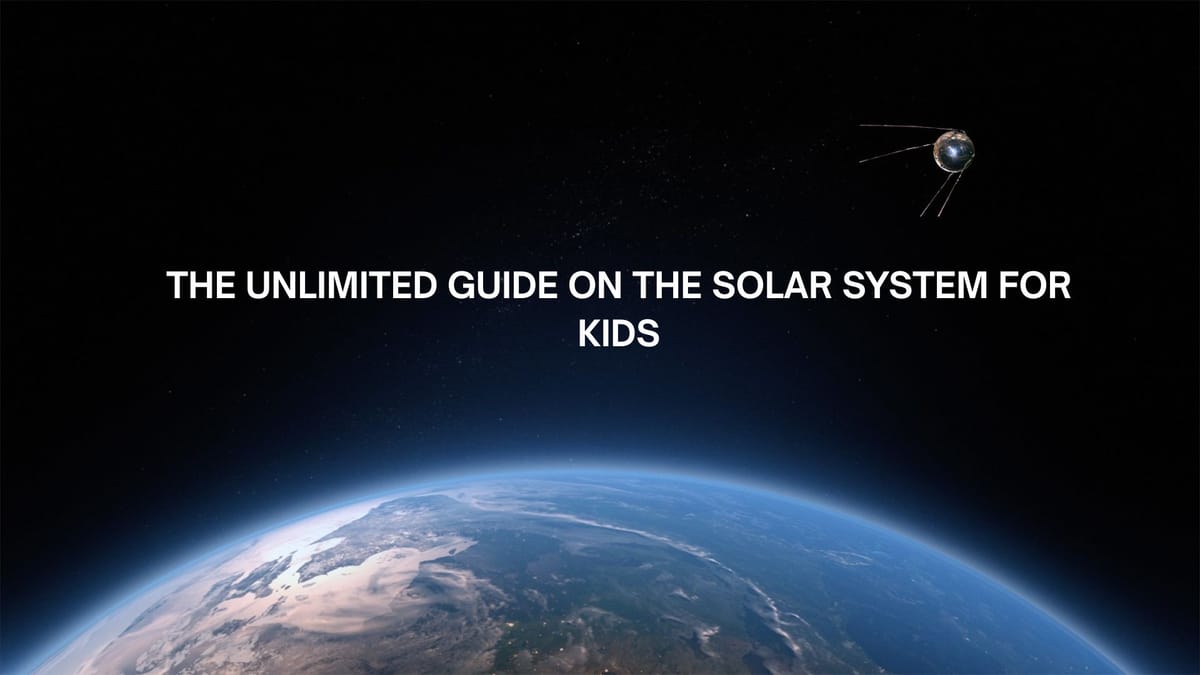
Our cosmic neighborhood is a busy, exciting place bound together by an invisible force called gravity. To help school students grasp these incredible scientific wonders easily, educators have developed creative ways to break down the cosmos. Using a specialized solar system for kids curriculum template, we can transform complex physics equations into a magical, unforgettable story of planets, moons, and blazing stars.
Whether you are trying to score top marks in your school geography class, preparing for a science exhibition, or simply dreaming of building the next generation of space rockets, this comprehensive guide will give you a clear map of our celestial backyard.
Exploring the Solar System for Kids: The Mighty Sun and Cosmic Gravity
At the absolute heart of our cosmic family stands a colossal, glowing ball of hot plasma: the Sun. The Sun is so unbelievably massive that it contains roughly 99.8% of all the matter in the entire solar system. Because it is so heavy, it possesses an immense gravitational pull. Think of gravity as a giant, invisible cosmic magnet or a massive, invisible merry-go-round; it is the force that firmly keeps every single planet, asteroid, and comet traveling along a steady, predictable pathway called an orbit.
Without the Sun's powerful gravitational grip, all the planets would simply drift away into the freezing darkness of deep space. For students studying the solar system for kids, understanding this relationship is the key to mastering space mechanics. Below is a quick-reference summary of our star's most amazing features:
- Estimated Age: Approximately 4.6 billion years old, currently in its middle age.
- Core Temperature: A scorching 15 million degrees Celsius (°C), hot enough to melt anything instantly
- Distance from Earth: About 150 million kilometers away, taking light just over 8 minutes to reach us.
- Classification: A yellow dwarf star, composed primarily of hydrogen and helium gases.
The Sun also provides the essential light and heat energy that allows life to thrive on Earth. Now that we have discovered the leader of our stellar neighborhood, it is time to turn our attention to the fascinating worlds that circle around it every single day.
Meet the Neighbors: Inner vs Outer Planets for Kids
The eight major planets in our cosmic family are divided into two completely different neighborhoods based on what they are made of and where they live. The four worlds closest to the Sun are known as the inner rocky planets, while the four located further away are called the giant outer gas and ice worlds. Exploring these distinct groups makes it much easier to memorize the various planets for kids who love astronomy.
The Rocky Inner Planets (Terrestrial Worlds)
The inner solar system contains solid, compact worlds made primarily of rock and metal. These worlds have warm surfaces where space probes can land:
- Mercury: The smallest and fastest planet in our system. Because it lacks an atmosphere to trap heat, its temperatures swing wildly from a blistering 430°C during the day to a freezing -180°C at night.
- Venus: Often called Earth's twin because of its similar size, Venus is wrapped in thick, suffocating clouds of carbon dioxide. These clouds act like a massive greenhouse, trapping heat and making it the hottest planet of all.
- Earth: Our precious, vibrant blue oasis. It stands out as the only known world in the universe that contains liquid surface water, a perfectly breathable atmosphere, and millions of living species.
- Mars: The famous red planet owes its rusty color to iron oxide covering its desert surface. It is home to Olympus Mons, the largest volcano in our cosmic neighborhood, which is three times taller than Mount Everest!
When studying these inner planets for kids, teachers often point out how Earth sits perfectly inside the habitable zone. The ideal distance from the Sun where it is neither too hot nor too cold for living organisms to survive.
Planets for kids: The Gas Giants and Ice Giants
Moving past the inner zone, we cross a massive gap into a realm of giant, frozen worlds that lack solid surfaces. These massive outer planets for kids offer a spectacular visual contrast to the rocky worlds:
- Jupiter: The undisputed king of the planetary family. Jupiter is a colossal gas giant so massive that all seven other planets could easily fit right inside it. It features a famous swirling storm called the Great Red Spot, which has been raging for hundreds of years.
- Saturn: Easily recognized by its breathtaking, glittering ring system, Saturn is a lightweight giant composed mostly of hydrogen. Its magnificent rings are made up of billions of chunks of pure ice, rocky debris, and cosmic dust.
- Uranus: A pale blue ice giant that has a very peculiar characteristic: it rotates completely on its side like a rolling bowling ball! Scientists believe a massive collision long ago knocked it over.
- Neptune: The outermost major world, Neptune is a deep-blue planet whipped by supersonic winds that travel faster than the speed of sound. It takes Neptune nearly 165 Earth years to complete just one single journey around the Sun.
Learning to sort the rocky surfaces from the gaseous clouds helps young space explorers build a solid foundation. Categorizing the inner and outer planets for kids clarifies how gravity organizes matter across vast distances.
Beyond the Planets: Asteroids, Comets, and Dwarf Worlds
A true exploration of the solar system for kids must look beyond just the eight major planets. Our cosmic family includes billions of smaller, mysterious objects that zip around space. Between the orbits of Mars and Jupiter lies a busy interplanetary highway known as the Asteroid Belt. This region is packed with millions of irregular space rocks left over from the formation of our universe.
Further out, in the freezing dark edges of our system, we find comets. Often described as dirty snowballs, comets are composed of frozen water, methane, and dust. When a comet's orbit brings it close to the warm Sun, the ice melts rapidly, creating a spectacular, glowing tail of gas that stretches across millions of kilometers. This dynamic landscape shows how varied the solar system for kids truly is.
We must also remember the famous story of Pluto. For many years, Pluto was counted as the ninth major planet. However, in 2006, astronomers established strict new criteria for planet classification. Because Pluto is very small and shares its orbital pathway with many other icy objects, it was reclassified as a dwarf planet.
Introducing these changing definitions within a solar system for kids guide teaches young minds that science is constantly growing as we build better tools to observe the sky.
Bringing the Solar System for Kids to Life with WhyCosmos
Reading textbook chapters and staring at flat diagrams can only take a student so far. To truly understand the mechanics of rocket launches, satellite orbits, and planetary geology, space education needs to become alive, tactile, and highly interactive. Passive video lectures often fail to spark deep curiosity; instead, students thrive when they are given the freedom to build, test, and analyze actual engineering models.
This is where WhyCosmos is completely transforming the landscape of science and aerospace education for school students across India. Moving far away from traditional memorization techniques, the platform offers dynamic, interactive live cohorts where children aged 8 to 16+ interact directly with specialized space mentors, participate in group brainstorms, and study real data tracks from historical space missions.
Through the engaging curriculum options hosted on the WhyCosmos Courses portal, students do not just read about the stars, they actively explore them. Younger learners can join our specialized courses like Astronomy 101 or Space Missions 103 to interact with 3D models of the Mars Curiosity Rover. The International Space Station and the Apollo lunar modules. Older students can dive straight into flight physics, computer fluid dynamics, or even learn how to code microcontrollers for simulated satellite missions.
By connecting academic school lessons with practical engineering tools, this modern approach turns a simple fascination with the solar system for kids into a life-changing educational journey. Parents can easily book a complimentary, live 45-minute demo session to witness firsthand how interactive space models can inspire their child to become a future aerospace leader.
Conclusion
Our planetary community is a wonderfully complex, massive frontier filled with infinite mysteries that are waiting to be solved by the next generation of thinkers. From the blazing solar fires of the Sun to the stormy dark blue atmosphere of Neptune, each celestial object teaches us a valuable lesson about the physical laws that govern our universe. By encouraging children to ask deep questions and look beyond their school textbooks, a foundational exploration of the solar system for kids opens up a pathway to critical thinking and scientific discovery.
As space research centers like ISRO continue to launch historic missions across the globe, there has never been a better or more inspiring time for Indian students to step into the world of astronomy. Keep looking up at the night sky, stay intensely curious, and never stop exploring the infinite wonders of our magnificent universe.
Frequently Asked Questions
Q1: Which is the coldest planet in our solar system?
While Neptune is the furthest from the Sun, Uranus holds the record for the lowest temperature ever measured, dropping to a freezing -224 degrees Celsius.
Q2: Why is Pluto no longer considered a regular planet?
Scientists reclassified Pluto as a dwarf planet because its gravitational pull is not strong enough to clear its orbital path of other surrounding icy debris and space rocks.
Q3: How can students in India start learning rocket science or astronomy early?
Students can enroll in interactive live cohorts on platforms like WhyCosmos, where they explore hands-on astronomy, real satellite telemetry data, and practical aeronautics tailored for young minds.
Q4: How many moons are there in total across all the planets?
There are over 200 confirmed planetary moons in our system, with gas giants Jupiter and Saturn claiming the highest number of moons circling their massive gravitational fields.